
Part one
When his name was mentioned, even the most renowned Hollywood producers were impressed: His presence on the screen—quiet, aloof, marked by a natural authority—defined an era of American cinema. Although he appeared in over fifty films and set milestones as a director, Robert Redford is one of those figures who challenged the Hollywood establishment by prioritizing independence and authenticity over glitz and glamour.
The native Californian grew up in modest circumstances in Santa Monica: Charles Robert Redford Jr., born on August 18, 1936, lost his mother Martha to blood poisoning when he was just six years old. His father, Charles Robert Redford Sr., worked as a milkman and later as an accountant for Standard Oil. The family moved to Van Nuys, where young Redford went to school with the children of film moguls like Dore Schary—an environment that brought him into early contact with the magic of cinema. But everyday life at that time was marked by numerous uncertainties: Pursuing a career as an actor probably wasn’t the first option that came to Redford’s mind back then. Initially, Robert Redford thought he would become a baseball player: Thanks to a scholarship at the University of Colorado, he perfected his skills as a pitcher, but parties and alcohol distracted him.
He dropped out of college, traveled through Europe—in Paris, bohemians discussed the Algerian War with him while he worked as a street painter—and returned to the USA to study theater design at the Pratt Institute. Robert Redford almost didn’t become an actor at all, but a set designer. If it hadn’t been for the call of the theater, because in 1959 he also enrolled at the American Academy of Dramatic Arts in New York and learned the art of acting.
The young father balanced family and career.
Broadway and First Steps
In 1959, Redford debuted on Broadway in the comedy Tall Story, followed by The Highest Tree. They were small roles, but they showed his potential: A young man with a clear gaze and an aura that captivated the audience despite his minor parts. In 1963 came the breakthrough with Neil Simon’s Barefoot in the Park, in which he played the newly married Paul Bratter—a role that made him the star of the show. The play ran over 1,500 times, and Hollywood took notice of the young actor. At the same time, he ventured into television: Guest roles in Alfred Hitchcock Presents (1961), The Twilight Zone (1962), and Route 66 (1961) followed. For an episode of Playhouse 90, he even received an Emmy nomination.
His screen debut was unspectacular: In War Hunt (1962), he played a soldier alongside John Saxon. But in 1965, in Inside Daisy Clover alongside Natalie Wood and Christopher Plummer, he was celebrated as a promising newcomer. Redford married Lola van Wagenen in 1958, a student he had met at the University of Colorado; the two moved to New York, where their children were born. The young father balanced family and career—a contrast to the wild parties he had known in his youth.
Did Redford know back then that his next role would link him to the Wild West forever—and to a name that a festival he initiated would later bear?
Sundance Kid
In 1967, Redford filmed Barefoot in the Park with Jane Fonda—a hit that solidified his film career. But the real turning point came in 1969: In Butch Cassidy and the Sundance Kid, he shared the screen with Paul Newman as the charismatic outlaw Sundance Kid. The Western by George Roy Hill became the box office hit of the year, won four Oscars, and made Redford an idol overnight. “It was like a bolt of lightning,” he later said about the chemistry with Newman. In the same year, he played the ski racer David Chappelet in Downhill Racer—a film he co-produced himself and which revealed his affinity for sports and nature.
The 1970s made Redford a symbol of the New Hollywood era: In The Candidate (1972), he portrayed the idealistic politician; in Jeremiah Johnson (1972), the solitary mountain man. In 1973 followed The Way We Were with Barbra Streisand as his film partner and Redford as the romantic historian Hubbell Gardiner—a film that grossed millions. In the same year, he starred in The Sting, again with Newman, who this time played the con man Johnny Hooker: The film won the Oscar for Best Picture and earned Redford his only acting nomination. “I wanted roles that had depth, not just surface,” he explained in a conversation with the New York Times. Observers would later describe this phase of Redford’s film career as the “hottest” phase of his career, during which there was no comparable actor in Hollywood.
Had the man who played outlaws and heroes already sensed that Hollywood’s clocks were ticking differently
In The Great Gatsby (1974), he shone as Jay Gatsby; in Three Days of the Condor (1976), as a CIA analyst. The highlight came in 1976 with All the President’s Men: In the role of Bob Woodward alongside Dustin Hoffman as Carl Bernstein, he exposed the Watergate scandal. The film received eight Oscar nominations and underscored Redford’s commitment to journalistic integrity. But amid all the success, behind the facade of the star lurked the director in him, who was concerned about the future of cinema: In 1969, Redford bought a ski resort in Utah, named it Sundance—after the film role that made him so famous that same year—and dreamed of a place for independent cinema.
Had the man who played outlaws and heroes already sensed that Hollywood’s clocks were ticking differently—and that he himself essentially had to reset the time?
From Actor to Visionary
At the end of the 1970s, Redford stood at a crossroads: The star’s shine was fading, while the studios bet on blockbusters. In 1980, he took the leap behind the camera: Ordinary People, a family drama based on Judith Guest’s novel, became his directorial debut. The film won the Oscar for Best Picture, and Redford received the Academy Award for Best Director—his first and only in that category. “It was risky, but necessary,” he said. The success confirmed: Redford was more than a face.
But the screen still called to him: In 1984, he shone in The Natural as the aging baseball hero Roy Hobbs, for which he was nominated for four Oscars. And then came Out of Africa—the adaptation of the world literature classic by Karen Blixen, which would put Redford’s skills as a character actor to the test. Would the Californian find his soul in Kenya—or was it just another chapter in a career that embodied freedom and solitude?
Main sources: Britannica: Robert Redford (2025); Biography.com: Robert Redford (2025)
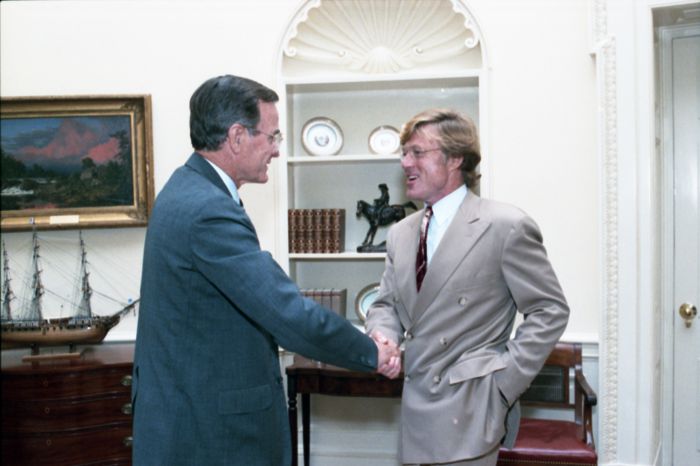
Cover picture: Robert Redford 1989 at the White House, © George Bush Presidential Library and Museum, Public domain, via Wikimedia Commons
Read more from Der Bussard
- Karen Blixen: Aristocrat or far-sighted rebel?
- John Barry: What would be a film without music?
- Paul Newman: Hombre (1.)
Hollywood at Der Bussard