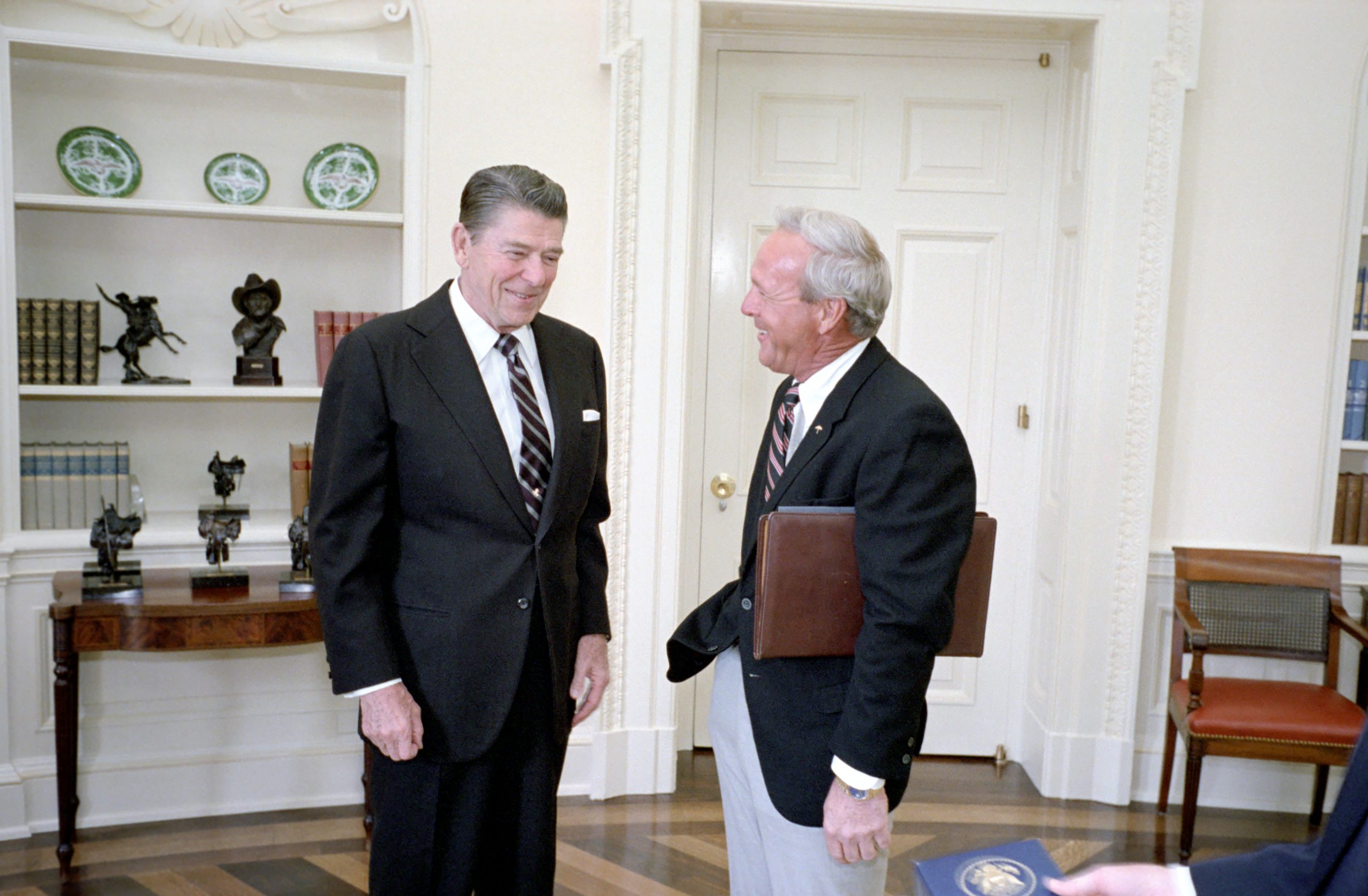

There is hardly a golfer who did more to take the sport out of the exclusive country clubs and bring it into the living rooms of America than Arnold Palmer. “The King” – that’s what the masses called him, not only because of his seven major championships, but above all because of the way he played: aggressive, bold, emotional, with a swing that made the earth tremble and a charisma that captivated millions. Where only a few had watched before, “Arnie’s Army” suddenly marched along – an army of fans who followed him everywhere and turned golf into a true American television sport.
The Road to Professional Golf
Arnold Daniel Palmer was born on September 10, 1929, in Latrobe, Pennsylvania, a small industrial town at the foot of the Allegheny Mountains. His father, Milfred “Deacon” Palmer, was the greenskeeper and club professional at Latrobe Country Club and introduced the young boy to golf. Arnold was hitting balls by the age of four. As a teenager, he won the Pennsylvania High School Championship twice. After high school, he attended Wake Forest College on a golf scholarship, but left the university in 1950 after the death of his close friend Bud Worsham and joined the U.S. Coast Guard. He served for three years, even building a small nine-hole course during his service, and returned in 1954 to win the U.S. Amateur Championship. That same year, he turned professional.
The Palmer Era
His first PGA Tour victory came in 1955 at the Canadian Open. The real breakthrough, however, arrived in 1958 when Palmer won the Masters Tournament – his first major championship. It marked the beginning of an era. By 1964, he had collected four Masters titles (1958, 1960, 1962, 1964), a dramatic U.S. Open victory in 1960 – where he trailed by seven strokes entering the final round, opened with birdies on six of the first seven holes, and closed with a 65 to win – as well as two British Opens (1961 and 1962).
In total, he secured seven major championships, 62 PGA Tour victories (the fifth-most in history), led the money list four times (1958, 1960, 1962, 1963), and won the Vardon Trophy four times for the lowest scoring average (1961, 1962, 1964, 1967).
Even by today’s standards – when young golfers regularly set new benchmarks for the sport – these remain staggering career achievements.
What set Palmer apart was his style: powerful, courageous, and unconventional.
Palmer’s Style
What set Palmer apart was his style: powerful, courageous, and unconventional. He attacked pin positions, never shied away from risk, loved booming drives and dramatic putts. When he failed, he did so spectacularly – and when he won, he celebrated with a clenched fist, hiked-up pants, and an infectious smile. He didn’t just play golf; he lived it. The television boom of the 1950s and 1960s found its perfect star in him: attractive, down-to-earth, charismatic, and from humble beginnings. Suddenly millions tuned in to watch “Arnie,” and “Arnie’s Army” grew into a genuine movement. Palmer made golf exciting, accessible, and emotional – stripping away the stiff image of the “old guard.”
Life Beyond the Golf Course
Off the course, Palmer built a business empire. He founded Arnold Palmer Enterprises, designed more than 300 golf courses worldwide (including Bay Hill, home of today’s Arnold Palmer Invitational), served as a brand ambassador for automobiles and beverages (the famous “Arnold Palmer” drink – half iced tea, half lemonade – still bears his name), bought his hometown club in Latrobe, and helped establish the Senior Tour (now PGA Tour Champions). He was the first golfer to earn one million dollars in prize money (1968) and remained approachable throughout his life: he signed autographs for hours and made a genuine effort to talk to every fan.
Golf Without Arnold Palmer? Hard to Imagine
Arnold Palmer died on September 25, 2016, at the age of 87 in Pittsburgh following complications from heart surgery. His ashes were scattered on the grounds of Latrobe Country Club – the place where it all began.
He was “The King” because he gave the game a modern face. Without Arnold Palmer, golf would never have become as big or as popular as it is today. Even now, he remains one of the most recognizable faces in golf, and it is thanks to his career that the sport found its way into countless American homes and continues to enjoy a strong fan base.
While the red jacket awarded to winners of the Arnold Palmer Invitational may not carry quite the same prestige as the green jacket worn by a Masters champion, Arnold Palmer remains one of the true giants of the game – a figure without whom golf would not be what it is today.
Cover picture: Arnold Palmer with President Reagan in the White House in April 1983. Public Domain, US National Archives. Taken from Wikimedia Commons.
Main sources: Palmer‘s biography at Encyclopedia Britannica, palmergolf.com and his biography at espn.com.
More Golf at Der Bussard